Key Features
Reliability in high duty cycle environments - Utilizing enterprise-class manufacturing processes, these drives are designed with enhanced reliability in a 24x7, high duty cycle environment.
Fast - With a next-generation SATA interface, up to 3 Gb/s data transfer rate, native command queuing (NCQ), and 16 MB cache, these drives deliver optimum performance.
Built to last - Made for years of high-performance operation around the clock. Reliability demonstration testing indicates a mean time between failure (MTBF) of one million hours.
RAID-specific time limited error recovery - Improves error handling coordination with RAID adapters and prevents drive fallout caused by extended drive error-recovery processes.
Fluid dynamic bearing (FDB) motor - Improves hard drive reliability; reduces heat, vibration, and noise.
Improved power controller - Consumes less power and generates low heat.
Data Lifeguard Tools - Software utility that works in conjunction with the embedded Data Lifeguard features (including shock protection, an environmental protection system, and embedded error detection and repair features) to make hard drive installation, management, and diagnostics simple and worry-free.
Hot plug support - Allows swapping of hard drives without having to power down the system or reboot; promotes system design flexibility, data availability, and serviceability.
Backplane compatibility - Uses the SATA industry standard connector which includes alignment ears and 3-stage electrical mating sequence, designed specifically for backplanes and hot pluggability.
SATA latching connector - Provides a secure connection between the hard drive and the cable connector via a locking latch mechanism.
|
Ideal For
- Servers
- Network attached storage
- Scientific computing
- Life sciences
- Video surveillance
- Enterprise backup
- Document/image management
- Audio/video media applications
- Other demanding write-intensive applications
Frequently Asked Questions
| Q: |
Regular 7200 RPM desktop drives run fine in RAID environments; why do I need these drives? |
| A: |
Unlike regular desktop drives, WD RE SATA and EIDE hard drives are engineered and manufactured to enterprise-class standards and include features such as time-limited error recovery that make them an ideal solution for RAID. |
| Q: |
What is time-limited error recovery and why do I need it? |
| A: |
Desktop drives are designed to protect and recover data, at times pausing for as much as a few minutes to make sure that data is recovered. Inside a RAID system, where the RAID controller handles error recovery, the drive needn't pause for extended periods to recover data. In fact, heroic error recovery attempts can cause a RAID system to drop a drive out of the array. WD RE2 is engineered to prevent hard drive error recovery fallout by limiting the drive's error recovery time. With error recovery factory set to seven seconds, the drive has time to attempt a recovery, allow the RAID controller to log the error, and still stay online. |
| Q: |
Will these drives work with my existing power supply? |
| A: |
The WD RE SATA drive has the new 15-pin SATA power as well as the legacy 4-pin power connectors. (Do not connect both connectors at the same time.) The WD RE EIDE drives use the industry-standard 4-pin power connector. |
| Q: |
What about SATA connections? Is the drive hot pluggable? |
| A: |
The WD RE SATA works with latching SATA cables, non-latching SATA cables and SecureConnect. SecureConnect is available only for WD SATA drives and provides additional structural support where the SATA cable connects to the hard drive. The WD RE drive is compatible with SATA backplanes and SATA hard drive carriers and, in those environments, is hot pluggable. |
| Q: |
For RAID environments I need SCSI data integrity. |
| A: |
The Serial ATA version includes 32-bit CRC error checking for all bits transmitted: command, data, and status. And, both SATA and EIDE versions include error checking to compare the data read back from the hard drive tob the data originally written to the hard drive. |
Important interface information
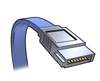 |
This drive requires a SATA interface
|
|
|